The problem explored
Connecting a form submission to CRM deal creation and conditional email follow-up.
A form-to-CRM workflow with AI processing and conditional email follow-up. The supplied diagrams document the configured connections, rather than verified production outcomes.
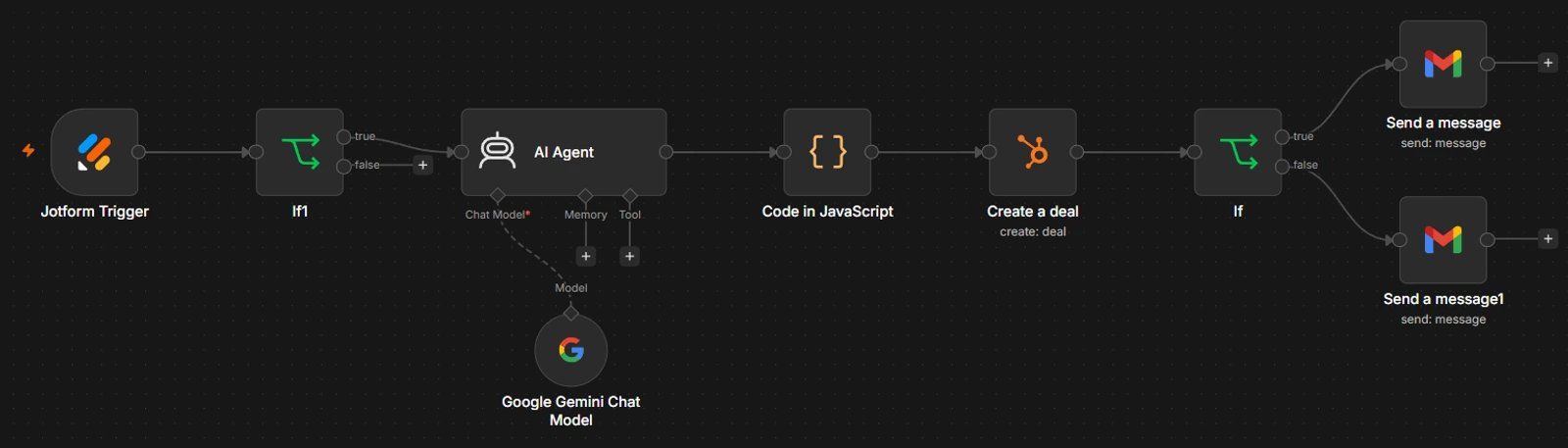
Scroll sideways to inspect the diagram. Zoom enlarges labels; Reset zoom restores this preview.
Architecture summary · read alongside the source
- Receive a submission
- Process the lead
- Create a CRM record
- Choose a follow-up
Inside the processing logic
Receive a submission
- Jotform Trigger is the first visible node.
- An If node follows the incoming submission.
- The condition and form fields are not visible in the screenshot.
Process the lead
- The selected path reaches an AI Agent.
- A Gemini chat model connects to the agent.
- A JavaScript code node follows the agent.
Create a CRM record
- The processed path reaches HubSpot Create Deal.
- The visible node indicates a deal-creation step.
- Deal fields, pipeline settings and scoring rules are not shown.
Choose a follow-up
- An If node follows HubSpot.
- Two Gmail send-message nodes form the outgoing branches.
- The screenshot does not expose either message template.
Step through the explanation
Dennice, an original illustrated robot guide, walks through the diagram. Start with Next, or choose autoplay. Captions and a full transcript are included; sound is optional.
Source evidence
These are the supplied local files used to write this explanation. Node labels and connections are visible; exported workflow JSON and execution logs were not supplied.
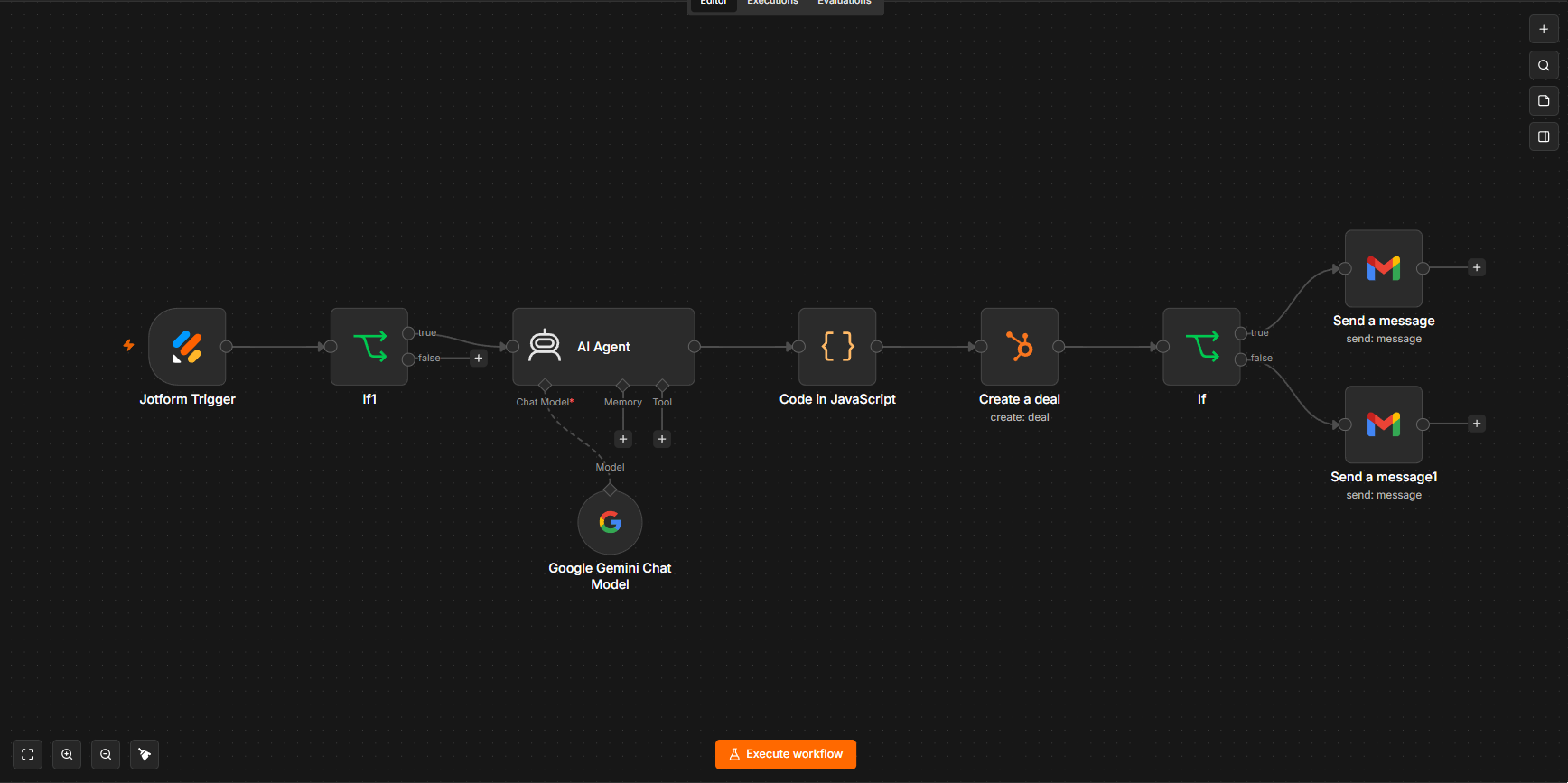
Visible outputs
A HubSpot deal followed by one of two Gmail message branches.
These outputs are represented by nodes in the source. Delivery success and business results require execution evidence.
What this case study does—and doesn't—verify
The image documents a form, processing, CRM and email sequence. No lead-conversion rate or sales result is evidenced. Validation and recipient checks should be verified before running it.
Next validation steps
Before operational use, I would inspect the workflow export, confirm credentials and permissions, test representative inputs and error paths, and review the outgoing messages with the intended user. These are proposed checks, not completed workflow execution tests.