The problem explored
Moving from a submitted resume to a recorded assessment and applicant response.
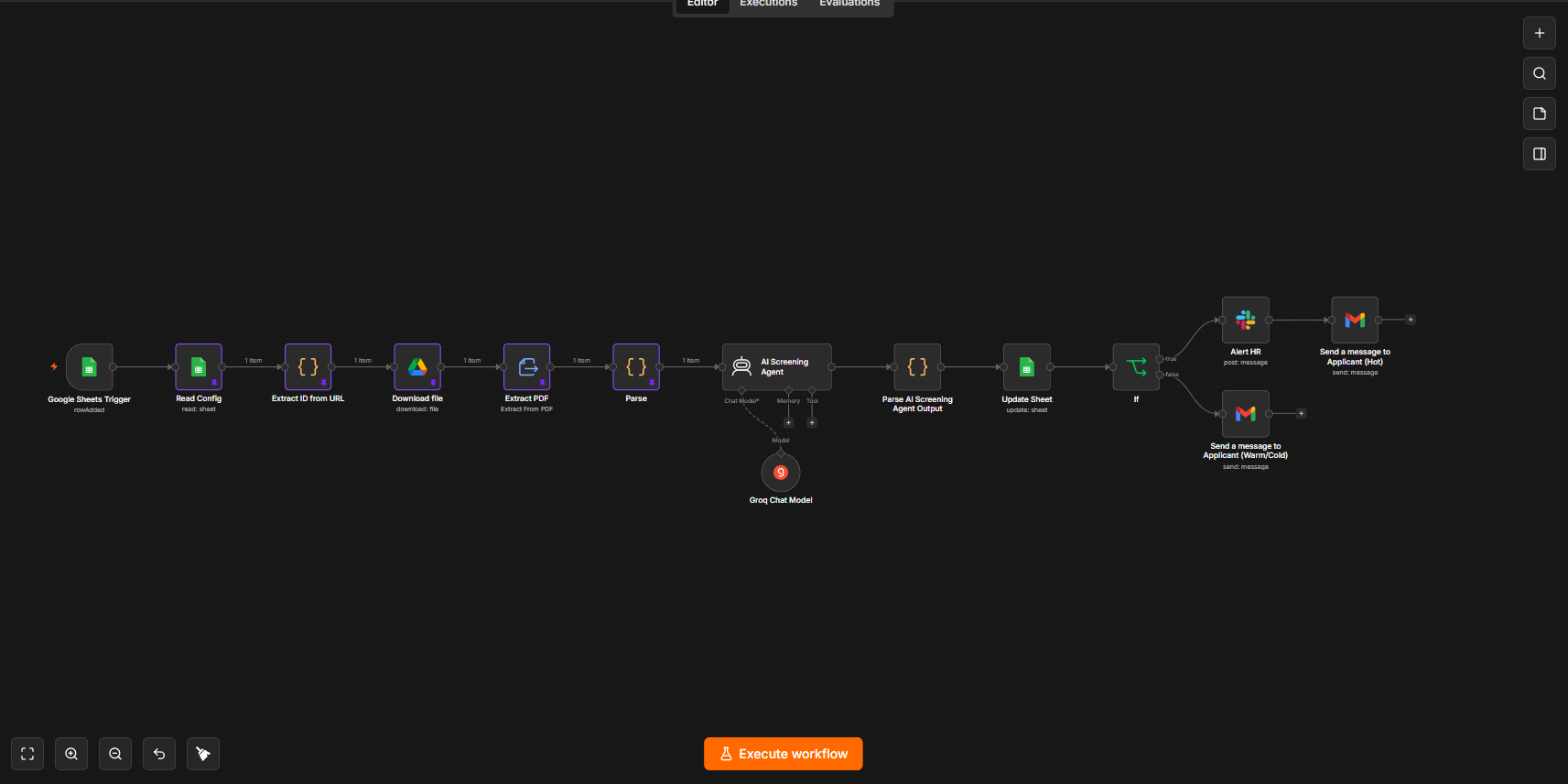
A document-to-review pipeline connecting applicant records, PDF extraction and screening output. The supplied diagrams document the configured connections, rather than verified production outcomes.

Scroll sideways to inspect the diagram. Zoom enlarges labels; Reset zoom restores this preview.
Architecture summary · read alongside the source
- Read an application
- Extract the resume
- Record the assessment
- Route the response
Inside the processing logic
Read an application
- A Google Sheets row-added trigger starts the visible workflow.
- ReadConfig follows the trigger before a URL-ID extraction code node.
- A Google Drive download node retrieves the referenced file.
Extract the resume
- An Extract PDF node follows the file download.
- A parsing code node prepares the extracted content.
- The prepared content reaches an AI Screening Agent connected to Groq.
Record the assessment
- A parser follows the screening agent.
- An Update Sheet node records the resulting output.
- The screenshot does not expose the screening prompt or evaluation rubric.
Route the response
- An If node branches after the sheet update.
- The diagram labels Gmail branches for Hot and Warm/Cold applicants.
- A Slack Alert HR node is visible alongside the Hot applicant path.
Step through the explanation
Dennice, an original illustrated robot guide, walks through the diagram. Start with Next, or choose autoplay. Captions and a full transcript are included; sound is optional.
Source evidence
These are the supplied local files used to write this explanation. Node labels and connections are visible; exported workflow JSON and execution logs were not supplied.
Visible outputs
A sheet update, applicant email branches and an HR notification in Slack.
These outputs are represented by nodes in the source. Delivery success and business results require execution evidence.
What this case study does—and doesn't—verify
This is a screenshot-based implementation case study. Fairness, hiring quality and classification accuracy are not validated by this image. Human review and a documented screening rubric should be verified before use.
Next validation steps
Before operational use, I would inspect the workflow export, confirm credentials and permissions, test representative inputs and error paths, and review the outgoing messages with the intended user. These are proposed checks, not completed workflow execution tests.